
The Story of Eat This Much
Eat This Much is a meal planning and nutrition app that builds personalised meal plans around a person’s calorie targets, dietary preferences and budget. Users start free and upgrade to a premium plan, so growth depends on getting the right people to install and then convert.
It is an established name in the category, with a strong organic presence and a substantial content library covering the questions its audience asks.
What has changed is not the product or the market, it is where those questions get asked. Across consumer software generally, a growing share of the research that leads to a download now happens inside ChatGPT and Google’s AI Mode rather than on a results page. The brief was to make sure Eat This Much is present and recommended in those answers, not only ranking on the page.
The Challenge: Being Recommended, Not Just Ranked
When someone asks ChatGPT for the best meal planning app, the assistant does not show ten options and let the user choose. It names two or three and moves on. If a brand is not among them, it does not rank lower. It is absent from the conversation entirely.
That creates two problems at once:
- Visibility. Assistants build answers from a small set of sources they trust, so a brand’s presence depends on what those sources say about it, not on its own website alone.
- Measurement. AI recommendations often produce no referral data, so a brand can be losing this battle with nothing showing up in its analytics.
Eat This Much needed three things: to be named in those answers, to know which questions it was absent from, and to prove the connection between that visibility and actual sign-ups. None of it was possible with rankings data alone.
Our Approach: Win the Sources AI Assistants Read
This is not a separate discipline bolted onto SEO. Assistants overwhelmingly draw on pages that already perform well in search, so strong fundamentals remain the foundation. What changes is where the work is aimed.
The strategy came from a simple observation: an AI assistant answers a recommendation question by reading the handful of pages that already answer it well, then repeating what they say. So the job is to make sure those pages exist, that they are excellent, and that Eat This Much appears in them, whether they sit on its own domain or somebody else’s.
That meant three workstreams running in parallel:
- Definitive guides on the questions buyers actually ask, on Eat This Much’s own site.
- Independent coverage in the third-party round-ups and comparisons assistants lean on.
- Measurement at the level of the question, not the keyword, so we could see which prompts named the brand, which named a competitor, and which sources drove each answer.
What We Did
1. Built a small set of definitive guides, not a content mill
Rather than publishing volume, we identified the specific questions that decide the category and built the best available answer to each:
- Best-of guides: meal planning apps, macro tracking apps, keto apps, and alternatives to the market-leading tracker.
- Full diet guides: keto, Mediterranean, vegan, vegetarian, paleo and low-carb.
Each was written to be genuinely useful to a reader first, then structured so a single passage still makes sense when an assistant lifts it out of the page. Fourteen pieces went live between March and July 2026.
2. Earned independent coverage in the articles that shape recommendations
Assistants and buyers both read third-party round-ups before deciding. We ran a sustained programme of editorial outreach to get Eat This Much included in those articles: best meal planning app round-ups, keto and Mediterranean app comparisons, family meal planning guides, and head-to-head pieces against the category’s better-known names.
Roughly thirty-five placements went live across the engagement, on health, lifestyle and consumer publications, each pointing at the most relevant page rather than the homepage.
3. Measured it at the level of the question
We set up prompt-level tracking across ChatGPT, Perplexity, Gemini and Google’s AI Overviews, using a set of 45 questions written the way real users ask them. Every answer is stored, so we can see exactly when the brand was named, where it appeared in the answer, which competitors appeared alongside it, and which sources the assistant drew on.
That gave us a feedback loop. Where a competitor was winning a question, we could see which article had persuaded the assistant, and go after it.
The Results
Visibility in AI answers
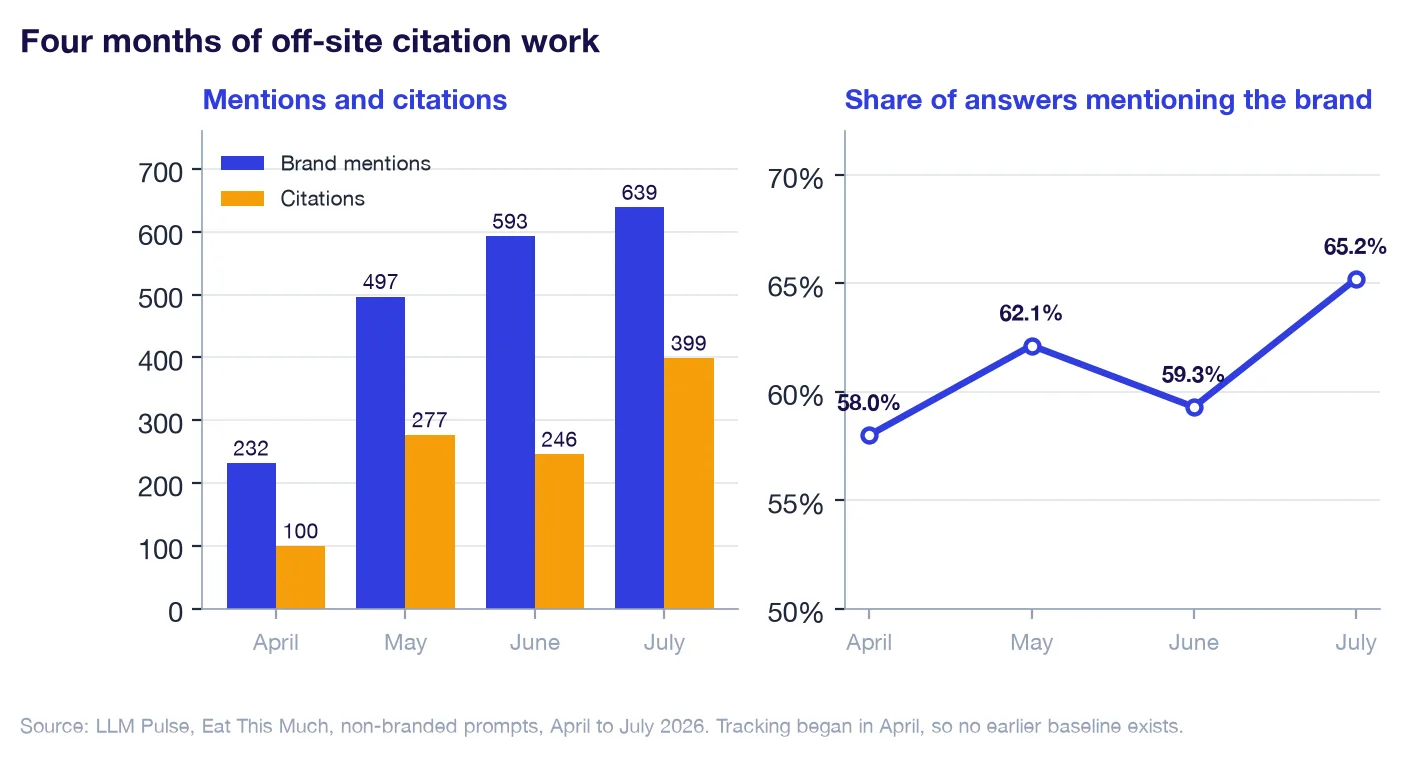
| Measure | April 2026 | July 2026 | Change |
|---|---|---|---|
| Brand mentions in AI answers | 232 | 639 | +175% |
| Citations of Eat This Much content | 100 | 399 | +299% |
| Share of answers mentioning the brand | 58.0% | 65.2% | +7.2pp |
Share of voice against the four nearest rivals now sits at around 39%, level with the category leader, up from roughly 35% at the start of May.
Second most-cited source in the category
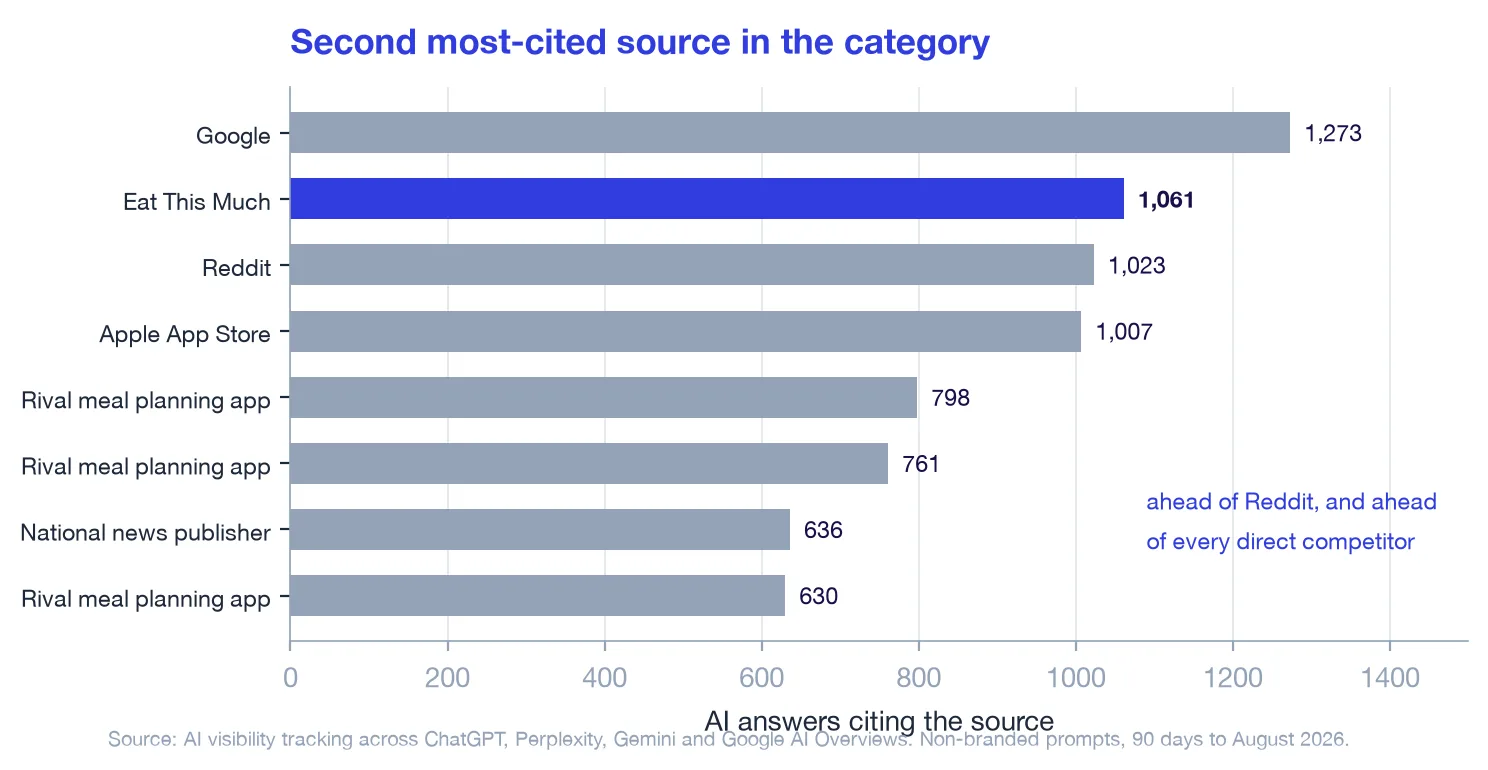
Across every buying question we track, Eat This Much is now the second most-cited source in its entire category, ahead of Reddit and ahead of every direct competitor. Only Google itself is cited more often.
The citations are also concentrated in a small number of pages. This was not a volume play.
The commercial effect
- Sign-ups from AI assistants roughly tripled, from a monthly average across the first four months of the year to a new run rate through May and June.
- Premium sign-ups arriving via ChatGPT increased more than sixfold over the same period, the clearest revenue signal from the work.
- AI-referred visitors convert at around 3.5%, roughly nine times the rate of visitors from organic search, because they arrive already recommended rather than still comparing.
- Eat This Much is now cited in Google’s AI Overview for questions including “best keto diet apps” and “best family meal planning apps”.
Traditional search moved with it
Which is the point about fundamentals:
- The keto app cluster went from outside the top 100 to positions three, four and five in a single month.
- “Mediterranean diet app” moved from ninth to fourth.
- Keywords ranking in the top ten tripled, from 77 to 211.
- Blog clicks grew 72% month on month.
Ready to be the brand AI recommends?
Search is splitting. Some questions still get answered on a results page, and some now get answered by an assistant that names two or three brands and stops. Being visible in both is a different job from ranking well, and it is one you can measure and win.
If you would like to know where your brand currently stands in AI answers, and what it would take to be the one that gets named, get in touch.
Ready to increase your organic web traffic?
We believe in working with complete transparency and will carry out tasks efficiently and cost effectively